The Final Battles
overview
At the end of the 70th Week (the final seven years of this age), Jesus the Messiah (Christ) will return to earth to rule and reign. It commonly is believed that, on the day He returns, He will attack and destroy the armed forces of the Antichrist at the Battle of Armageddon. Although this encounter will occur, it can be demonstrated, by carefully examining Scripture, that it will not happen as soon as Jesus returns but, rather, soon thereafter (that is, a month later).
Concerning the day on which the armies of Gog/Magog are eliminated, the prophet Ezekiel wrote this:
From that day forward the house of Israel will know that I am the LORD their GodIn the past, there have been times when Israel acknowledged the Lord their God. However, never “from that day forward” have they maintained a constant acknowledgement and acceptance of the Lord their God. Instead, they always have back-slidden away from God, and much of Israel is in that condition today.(Ezekiel 39:22).
Therefore, it makes very little sense that the prophecy in
The armies Jesus will “trample,” like grapes in a winepress
At that time, Jesus will be on His throne in Jerusalem as King over the whole earth
treading the winepress
As is written in the Book of Revelation, John envisioned the future return of the Lord Jesus—the “Faithful and True” and the “King of kings and Lord of lords”—to earth as the Rider on a white horse, with the armies of heaven following Him
Besides coming to rule and reign on the earth, John described that Jesus will have yet another very specific mission (which is what the first verse of the song “Battle Hymn of the Republic” is referring to):
He treads the winepress of the fury of the wrath of God Almighty(Revelation 19:15c).
John did not see Jesus being still or passive. Rather, John noted that “he judges and makes war”
The great Old Testament prophet Isaiah foretold this same scene of the future, including the crimson (red) garments, the treading of the winepress, and the Lord’s sword
John foretold Jesus’ return in three parallel passages:
Apparently, there will be a secondary rapture (catching up) of some saved believers, just before Jesus descends to earth, at the end of the 70th Week
Yet another Old Testament prophet, Joel, had a similar observation about swinging a sickle to harvest these wicked “grapes,” to be trampled in the winepress
The Valley of Jehoshaphat is the primary location where Jesus will destroy the armies of the Gog/Magog nations attacking Jerusalem. These are not the armies of the Antichrist; all of the latter will be destroyed, 30 days later, after they have gathered on the plain of Megiddo, with the intent of going to Jerusalem to attack Jesus—after He has returned and is sitting as King in Jerusalem
Joel also wrote,
I will gather all nations and bring them down to the Valley of Jehoshaphat. There I will enter into judgment against them concerning my inheritance, my people Israel, for they scattered my people among the nations and divided up my landThis is a parallel description to a passage written by Ezekiel:(Joel 3:2).
Therefore, son of man, prophesy and say to Gog: “This is what the Sovereign LORD says: In that day, when my people Israel are living in safety, will you not take notice of it? You will come from your place in the far north, you and many nations with you, all of them riding on horses, a great horde, a mighty army. You will advance against my people Israel like a cloud that covers the land. In days to come, O Gog, I will bring you against my land, so that the nations may know me when I show myself holy through you before their eyes. ... I will execute judgment upon him...and on his troops and on the many nations with him”Note that both passages describe how God will enter into, or execute, “judgment” against/upon the “nations” who will be attacking Israel. God’s coming against these “nations” also is shown in the following parallel passages by Isaiah, Zechariah, and John:(Ezekiel 38:14-16,22).
But your many enemies will become like fine dust, the ruthless hordes like blown chaff. Suddenly, in an instant, the LORD Almighty will come with thunder and earthquake and great noise, with windstorm and tempest and flames of a devouring fire. Then the hordes of all the nations that fight against Ariel, that attack her and her fortress and besiege her, will be as it is with a dream, with a vision in the night...(Isaiah 29:5-7).
I will gather all the nations to Jerusalem to fight against it; the city will be captured, the houses ransacked, and the women raped. Half of the city will go into exile, but the rest of the people will not be taken from the city. Then the LORD will go out and fight against those nations, as he fights in the day of battle(Zechariah 14:2,3).
Out of his mouth comes a sharp sword with which to strike down the nations. “He will rule them with an iron scepter.” He treads the winepress of the fury of the wrath of God Almighty(Revelation 19:15).
great supper of God
After John’s reference to the treading of the winepress, he described how all the birds flying in midair will be told,
Come, gather together for the great supper of God, so that you may eat the flesh of kings, generals, and mighty men, of horses and their riders, and the flesh of all people, free and slave, small and greatThis description parallels that which was written by Ezekiel (in one of his God/Magog passages) in describing what will be told to the birds and wild animals, for which God will prepare a sacrifice on the mountains of Israel and surrounding region:(Revelation 19:17,18).
“Assemble and come together from all around to the sacrifice I am preparing for you, the great sacrifice on the mountains of Israel. There you will eat flesh and drink blood. You will eat the flesh of mighty men and drink the blood of the princes of the earth.... At my table you will eat your fill of horses and riders, mighty men and soldiers of every kind,” declares the Sovereign LORDMoreover, those who will be destroyed have been likened to “rams and lambs, goats, and bulls”(Ezekiel 39:17,18a,20).
the Lord known by all
Soon after the Lord Jesus returns to earth at the end of the 70th Week, the whole world (including the Antichrist) will know about it. For one thing, on that day, there will be a great earthquake in the land of Israel; the people of the earth will tremble at His presence, and mountains will be overturned
At that time, Jesus will become the Lord of Israel forever
I will no longer hide my face from them, for I will pour out my Spirit on the house of Israel, declares the Sovereign LORDThe Old Testament prophet Zechariah also described how God would pour out His spirit on the house of David (Israel):(Ezekiel 39:29).
And I will pour out on the house of David and the inhabitants of Jerusalem a spirit of grace and supplication. They will look on me [Jesus], the one they have pierced, and they will mourn for him as one mourns for an only child, and grieve bitterly for him as one grieves for a firstborn sonZechariah described, as well, how the nations will be gathered against Israel, in particular Jerusalem, at that future time(Zechariah 12:10).
fuel for seven years
Many believe that the great slaughter of the armies of Gog and Magog will occur just prior to the beginning of the 70th Week, which lasts for seven years. This is because Ezekiel described how those who live in Israel will use the weapons for fuel for seven years
However, this one verse, standing on its own, cannot be used to demonstrate that the seven years in question are equivalent to the so-called “tribulation” period. In fact, it has been commonplace for God to use periods of “seven” in the past, for various activities, such as the following (most of which involve seven-year periods):
- performing His acts of creation in six “days” and resting on the seventh “day”
(Genesis 2:2,3), - waiting seven days after commanding Noah to bring the animals onto the ark before sending the rain
(Genesis 7:4), - having Jacob agree to work seven years in return for receiving Rachel
(Genesis 29:18,20,27,28), - causing seven years of abundance and seven years of famine in the land
(Genesis 41:26,29,30,53,54), - counting off seven sabbaths of years for the jubilee
(Leviticus 25:8). - commanding that debts be canceled after seven years
(Deuteronomy 15:1), - giving the Israelites into the hands of the Midianites for seven years
(Judges 6:1), - allowing David to rule over Israel in Hebron for seven years
(1 Kings 2:11), - having the first temple built in seven years
(1 Kings 6:38), and - causing another famine in the land for seven years
(2 Kings 8:2).
Also, consider the weapons that will be burned for fuel: “the small and large shields, the bows and arrows, the war clubs and spears”
Gog and Magog
In the Old Testament, a “prince” can indicate a demonic or angelic being who, in the spirit realm, is in control of a nation, such as Persia, Greece, or (in the case of the archangel Michael) Daniel’s people, Israel
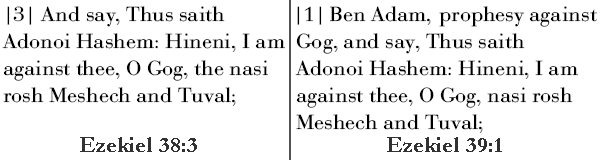
Some English translations incorrectly state “prince of Rosh” and many have interpreted “Rosh” to be a reference to Russia. Yet, the regular Hebraic meaning of “rosh” is “head” or “chief”; for instance, “Rosh haShanah” means “head of the year”—that is, the Hebrew new year. Therefore, Gog will be, simply, the chief (“rosh”) prince of Meshech and Tubal. It certainly is possible, though, that Russia will be allied with the hordes of Gog and Magog.
Those who consider “Rosh” to be Russia usually will equate “Meshech” and “Tubal” with the two Russian cities, Muscova (Moscow) and Tobol’sk (Tubalsk), respectively. However, it seems more likely that they refer to Mushki and Tabal in ancient Anatolia or Asia Minor, which constitutes the major part of modern-day Turkey. Therefore, Gog may emerge from Turkey.
In a passage about Tyre, Ezekiel mentions many places that traded and did business with Tyre, including Tubal and Meshech
From
Magog, Meshech, Tubal, and Gomer were sons of Japheth
Although there is some disagreement as to the extent of the land of Magog, we do know that Gog, the chief (“rosh”) prince of Meshech and Tubal, will be “of the land of Magog”
See more details on Rosh, Meshech, Tubal, and Put. See other theories about the identities of Gog and Magog.
day of vengeance
Jeremiah named Cush and Put, nations mentioned by Ezekiel as part of the Magog hordes
Charge, O horses! Drive furiously, O charioteers! March on, O warriors—men of Cush and Put who carry shields, men of Lydia who draw the bow. But that day belongs to the Lord, the LORD Almighty—a day of vengeance, for vengeance on his foes. The sword will devour till it is satisfied, till it has quenched its thirst with blood. For the Lord, the LORD Almighty, will offer sacrifice in the land of the north by the River EuphratesThere are distinct similarities to Isaiah’s description, in which he equated the “day of vengeance” with a “year of retribution”:(Jeremiah 46:9,10).
The sword of the LORD is bathed in blood, it is covered with fat—the blood of lambs and goats, fat from the kidneys of rams. For the LORD has a sacrifice in Bozrah and a great slaughter in Edom. ... For the LORD has a day of vengeance, a year of retribution, to uphold Zion’s causeJeremiah indicated that God would bring a year of punishment upon Moab:(Isaiah 34:6,8).
“Whoever flees from the terror will fall into a pit, whoever climbs out of the pit will be caught in a snare; for I will bring upon Moab the year of her punishment,” declares the LORDFurthermore,(Jeremiah 48:44).
Gog, the King?
In the Septuagint (a Greek translation of the Old Testament), there is a reference to Gog in this verse, indicating that he may be the king of a “swarm of locusts”:
Thus the Lord showed me, and behold a swarm of locusts were coming, and, behold, one of the young devastating locusts was Gog, the KingNow, literal locust insects do not have a leader or “king”(Amos 7:1).
A swarm of demonic locusts is seen to come out of the Abyss during the Fifth Trumpet Judgment
Near the end of the 70th Week, then, it seems plausible that a future leader will become possessed by the demonic spirit, Gog, and will head a conglomerate of demonic and Islamic armies. The armies of many other nations will join the armies of Gog and Magog, and altogether they will come from the north to invade Israel
Gog vs. Antichrist
I am convinced not only that the Gog/Magog bloodbath is the same as the winepress of God’s wrath, but also that it will take place at the very end of the 70th Week. Many who assume (I believe erroneously) that the Battle of Armageddon will occur immediately upon the termination of the final seven years, on the day that Jesus returns to earth, have come to the conclusion that Gog and the Antichrist will be one and the same person. I completely disagree. (See also the Assyrian.)
We know that Gog will come from the north to attack Israel:
You will come from your place in the far north, you and many nations with you, all of them riding on horses, a great horde, a mighty army. You will advance against my people Israel like a cloud that covers the land. In days to come, O Gog, I will bring you against my land, so that the nations may know me when I show myself holy through you before their eyesNow,(Ezekiel 38:15,16).
...the king of the North will storm out against him with chariots and cavalry and a great fleet of shipsI believe it is plausible to surmise that, ultimately, there will be a clash between the forces of Gog (perhaps the al-Mahdi, the coming “redeemer” of radical Islam) and the forces of Antichrist, at least for control of Israel and even for domination of regions of the world. If so, I see this, most likely, as escalating during the final 3½ years of the 70th Week, especially within the final year of that period. Until then, I feel that many nations in the world gradually will become “polarized,” coming under the control of one form of Islam or another, perhaps moderates against radicals.(Daniel 11:40).
A possible scenario, though speculative, is this: After the Antichrist proclaims himself to be “God” and sets up the “abomination that causes desolation” in the “holy place”
In my Chronology of Revelation commentary, I have noted how it is plausible that the Antichrist and his forces may come to be centered in Mecca, Sauda Arabia, which potentially could be the center of “Babylon the Great.” In any case, another ancient prophet spoke how a nation from the north would attack Babylon:
This is the word the LORD spoke through Jeremiah the prophet concerning Babylon and the land of the Babylonians: ... “A nation from the north will attack her and lay waste her land. No one will live in it; both men and animals will flee away. For I will stir up and bring against Babylon an alliance of great nations from the land of the north. They will take up their positions against her, and from the north she will be captured”Also,(Jeremiah 50:1,3,9).
“Then heaven and earth and all that is in them will shout for joy over Babylon, for out of the north destroyers will attack her,” declares the LORD. “Babylon must fall because of Israel's slain, just as the slain in all the earth have fallen because of Babylon”Babylon was attacked and overthrown, in ancient times, by Medo-Persia (see Nebuchadnezzar’s statue). However, many prophecies in the Bible have dual fulfillments, both short-term and long-term. Jeremiah evidently was talking about a permanent and unrecoverable destruction of Babylon; he wrote that after it has been destroyed, no man or animal would live in it again, because it would be desolate forever(Jeremiah 51:48,49).
Persia is modern-day Iran, an Islamic nation. Prophetically, it appears that Gog of the land of Magog will be allied with Persia
One possibility is that while the Antichrist is residing in “Mystery Babylon,” wherever that may turn out to be (I suspect Mecca, Saudi Arabia), Gog will threaten to engage him in battle there. As a result, the Antichrist might think that it is in his best interest to escape; so he and some of his armies will invade Israel (“the Beautiful Land”—
Jesus said this:
Every kingdom divided against itself will be ruined, and every city or household divided against itself will not stand. If Satan drives out Satan, he is divided against himself. How then can his kingdom stand?(Matthew 12:25,26).
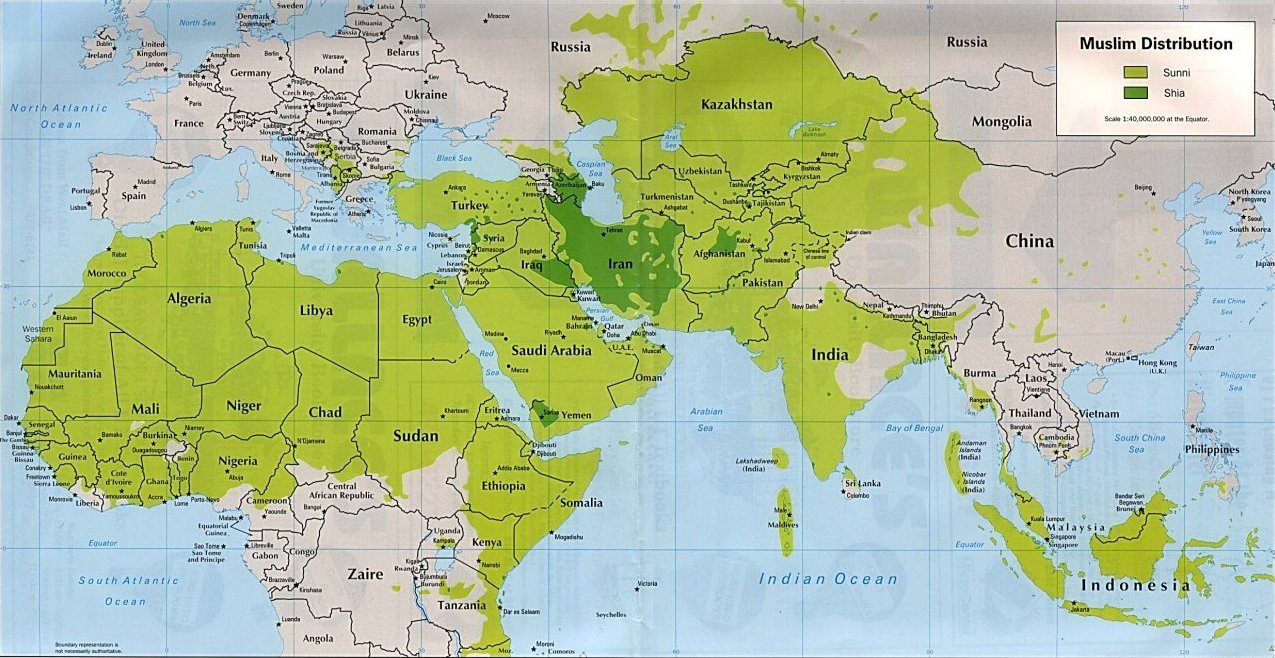
Both of the main branches of Islam, Sunni and Shi’a, seek the absolute destruction of Israel. I believe it is very plausible that the forces of Gog/Magog will be one branch of Islam and the forces of the Antichrist another branch, both vying to capture the ultimate “prize,” Israel, and engaging in conflicts with each other along the way.
Looking at the map below, we should keep in mind the major Arab uprisings within many nations during 2011 and in subsequent years. These very well could result in the radical Islamization of many formerly moderate Islamic nations, such as Libya, Syria, Egypt, Algeria, and others.
See Larger View
Very near the end of the age, Satan will know that his time is short
extensions to the 70th Week
Before describing when I believe the Battle of Armageddon and the destruction of the Antichrist will take place, I feel it is important to understand a brief but very important passage written by the ancient prophet Daniel:
From the time that the daily sacrifice is abolished and the abomination that causes desolation is set up, there will be 1,290 days. Blessed is the one who waits for and reaches the end of the 1,335 daysThe first thing that this prophecy indicates is that there will be a 1,290-day time period, which will begin at the time the “daily sacrifice is abolished” and the “abomination that causes desolation is set up,” in the middle or midst of the 70th Week(Daniel 12:11,12).
1,260 days
Jesus warned that, at that time, those in Judea should “flee to the mountains”
This accounts for 1,260 of the 1,290 days in the first part of the prophecy given to Daniel
30 days
Recall how the prophet Zechariah, speaking of the Messiah who would come, wrote that “they will look on me, the one they have pierced [Jesus] and mourn for him as one mourns for an only child, and grieve bitterly for him as one grieves for a firstborn son”
Similarly, since Aaron and Moses were “types” of Jesus in what they stood for and did (sacrificing for the people, as well as leading them to new heights), it seems quite plausible that 30 days is the period of time the people in Israel again will mourn in respect for their ultimate Leader, Jesus. He will have sacrificed His life for them (at His first coming), as well as delivered them from the clutches of the armies of Magog and the allied nations under Gog (at His second coming).
The nation of Israel never properly mourned for the death of Jesus, their beloved Messiah, after His crucifixion; however, during the 30 days following His next return, I believe they will. This 30-day period will be one of two extensions to the 70th Week fulfilling
Furthermore, I suspect that this 30-day period will be a time of national repentance, during which Israel will forsake all idol worship, destroy all graven images, and acknowledge Jesus as King of kings and Lord of lords. At this time, and forevermore thereafter, Israel will be purified and cleansed from its transgressions, sins, and unrighteousness. This will fulfill a portion of the prophecy, given by Gabriel to Daniel, of what will happen at the conclusion of the seventy “sevens” or “weeks” of years:
Seventy “sevens” are decreed for your people and your holy city to finish transgression, to put an end to sin, to atone for wickedness, to bring in everlasting righteousness, to seal up vision and prophecy and to anoint the most holyIt will be at the end of that subsequent 30-day period that the Antichrist and His armies, enraged that the seven Bowl Judgments of God’s wrath(Daniel 9:24).
The Antichrist and His armies will be preparing to make war against the Lamb, Jesus (Revelation 17:12-14, 19:19), Who already will have been sitting on His throne in Jerusalem since having returned to earth 30 days prior to that. Then Jesus will go out to meet them for battle, destroying them all at the Battle of Armageddon. Thus, control and influence by the Antichrist will extend from the day the abomination that causes desolation is set up until he is defeated in the Battle of Armageddon: 1,260 days + 30 days = 1,290 days
Interestingly, King Darius once issued an edict stating that, for 30 days, no one could worship any god or man other than himself. Whoever did so would be thrown into the lion’s den
Bowl Judgments
After Jesus descends to earth as the Rider on a white horse, the Seventh Trumpet will sound, indicating that He has “begun to reign” and will have the immediate mission of “destroying those who destroy the earth”
John wrote, “All nations will come and worship before you, for your righteous acts have been revealed”
Sukkot begins 5 days after Yom Kippur (the Day of Atonement); and I believe Yom Kippur is the actual day that Jesus will return physically to earth, at the end of the 70th Week. At His first coming, Jesus rode into Jerusalem on a donkey
We know that “without the shedding of blood there is no forgiveness” of sins
Each year, Yom Kippur falls on the tenth of the first month (Tishri) on the Hebrew civil calendar. (On the religious calendar, this Day of Atonement is on the tenth of the seventh month—
For those nations not sending representatives to worship Jesus and to celebrate the Feast of Tabernacles (Sukkot) in Jerusalem, the Lord will bring a “plague” upon them
Battle of Armageddon
I have shown what I believe will occur in conjunction with Jesus’ physical return to earth, when the Seventh Trumpet is blown. John described how Jesus, wearing a robe dipped in blood
After this, John began a new section with the word Then (in the NIV). I believe that what follows is a depiction of what will occur next: The Antichrist (or “beast” ), along with “the kings of the earth and their armies,” will gather together “to make war against the rider on the horse and his army”
The ten kings, allied with the beast/Antichrist, will have received authority “for one hour”
As explained before, the forces of Gog and Magog and all the nations with them will attack Israel and Jerusalem
 The “king” (Antichrist) who exalts and magnifies himself
He will pitch the tents of his royal pavilion between the seas and the beautiful Holy Mountain; yet he will come to his end, and no one will help him (Daniel 11:45—New American Standard Version).In Jerusalem, after Jesus returns, He will be at His millennial Temple and Holy Mountain (probably the Mount of Olives, after it has risen up due to a great earthquake—Zechariah 14:4,5). The Antichrist and his forces will gather on the plain of Megiddo (north of Jerusalem), taking a final stand against Jesus. But Jesus will come out and conquer them all.
Zechariah noted, “Then the LORD will go out and fight against those nations, as he fights in the day of battle”
Some believe that Gog and the Antichrist are the same person and that there is only one huge battle at the end of the 70th Week. I completely disagree. The human leader Gog will be given “a burial place in Israel”
kings of the earth
During the 30 days following Jesus’ return to earth, He will be in Jerusalem, and the Bowl Judgments will be poured out upon the kingdom of the Antichrist. As a result, those being afflicted by the plagues will suffer greatly and will curse God
The enraged kings of the earth and their armies, who have been deceived by the Antichrist, will gather together against God’s Anointed One—that is, the Messiah, Jesus. He will have been installed as King on God’s holy hill in “Zion”—that is, in Jerusalem. In a Psalm, King David described these things:
Why do the nations conspire and the peoples plot in vain? The kings of the earth take their stand and the rulers gather together against the LORD and against his Anointed One. “Let us break their chains,” they say, “and throw off their fetters.” The One enthroned in heaven laughs; the Lord scoffs at them. Then he rebukes them in his anger and terrifies them in his wrath, saying, “I have installed my King on Zion, my holy hill”These kings of the earth are the same ones who will have given their power and authority to the beast (Antichrist) and who will make war against the Lamb, Jesus; but He will overcome them:(Psalm 2:1-6).
The ten horns you saw are ten kings who have not yet received a kingdom, but who for one hour will receive authority as kings along with the beast. They have one purpose and will give their power and authority to the beast. They will make war against the Lamb [Jesus], but the Lamb will overcome them because he is Lord of lords and King of kings—and with him will be his called, chosen and faithful followersWhile the Antichrist “beast,” the False Prophet “beast”(Revelation 17:12-14).
Jesus’ coming “like a thief”
God always forewarns people before He passes judgment, in case there are any who might choose to heed the warning. Perhaps some who have read the book of Revelation will see that Jesus is about to come “like a thief” and wipe them out, and they will have a change of heart, beg for His mercy and protection, and be spared.
45 days
In the brief prophecy given to Daniel, there still is an accounting to be made for the period of 1,335 days
As stated before, I believe that Jesus will return to earth, at the end of the 70th Week, on a Yom Kippur, the Day of Atonement.
 Hanukkah Candles: Night #2 |
Hanukkah is the 8-day festival of lights, celebrating the rededication of the ancient Jewish temple in Jerusalem after it had been desecrated by the Syrians. At that time, the lamps miraculously stayed lit for eight days while the temple was being rededicated, even though there was enough oil for only one night’s light.
After Jesus comes back to Jerusalem, a new Millennial Temple (see Ezekiel chapters 40–47) will be constructed (see also millennial Temple and Holy Mountain). It would make sense, then, that the new, glorious Temple will be dedicated during Hanukkah, 75 days following Jesus’ return to rule and reign. This also will be 1,335 days after the abomination that causes desolation is set up (in fulfillment of Daniel 12:11,12) and 45 days after the defeat of the Antichrist and his armies at the Battle of Armageddon.

Ted’s Bible Commentaries
and Other Links

Comments or questions? Email Me.

Copyright © 2004– by Ted M. Montgomery, O.D. Most rights reserved.
THE HOLY BIBLE, NEW INTERNATIONAL VERSION®, NIV®
Copyright © 1973, 1978, 1984, 2011 by Biblica, Inc.®
Used by permission. All rights reserved worldwide.