Good Thursday
overview
The days of the week have different names on the Hebraic calendar compared to the Roman calendar. The following chart shows both sets of names; however, for ease of understanding, the Roman days of the week will be used throughout this commentary:
Days of the Week
Hebrew Names and Roman Names
| Day Number | Hebrew Name | Roman Name |
|---|---|---|
| First Day | Yom Rishon | Sunday |
| Second Day | Yom Sheni | Monday |
| Third Day | Yom Shlishi | Tuesday |
| Fourth Day | Yom Revi’i | Wednesday |
| Fifth Day | Yom Chamishi | Thursday |
| Sixth Day | Yom Shishi | Friday |
| Seventh Day | Yom Shabbat | Saturday |
In ancient Israel, including during the first century A.D., preparations for the Pesach or Passover feast took place on “Preparation Day.” On that day, in the middle of the afternoon (that is, at beyn ha’arbayim, often referred to as “twilight”), the Passover lamb was sacrificed at the temple in Jerusalem. After sunset, when Preparation Day had ended and the Feast of Unleavened Bread had begun, the lamb and other specific foods for the Pesach feast were eaten.
Jesus was crucified and died on Preparation Day. Traditionally, this has been thought to have been on a Friday. I would like to demonstrate that Jesus’ crucifixion and death did not occur on a Friday (the sixth day of the week), as has been traditionally accepted, but rather on the previous day, Thursday (the fifth day of the week).
At that time, the days of the week were referred to as the “first day,” the “second day,” the “third day,” and so on, rather than as Sunday, Monday, Tuesday, etc., which were named after various planets and deities. For ease of understanding by the “Western” mind, though, I will refer to the days of the week as we do today.
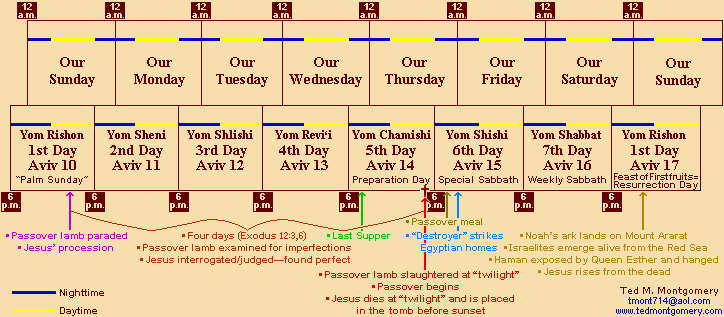
My Holy Week chart, near the bottom of this page, displays my depiction of the week during which the following occurred in the month of Aviv (also called Nisan) of that year:
- Jesus entered Jerusalem riding on a donkey (on Palm Sunday, Aviv 10), as prophesied in
Zechariah 9:9; - He was crucified four days later (on Thursday, Aviv 14); and
- He was resurrected from the dead on the third day after that (on Sunday, Aviv 17).
Some believe that Jesus was crucified on a Wednesday. The crucifixion not on Wednesday section demonstrates why I am convinced that this was not the case. The “three days and three nights” in the
Pesach or Passover
While the Israelites were being held captive in Egypt, God described to Moses and Aaron when and how the first Passover should take place
On Aviv (or Nisan) 10, each household was to take in a lamb without defect
  |
 .
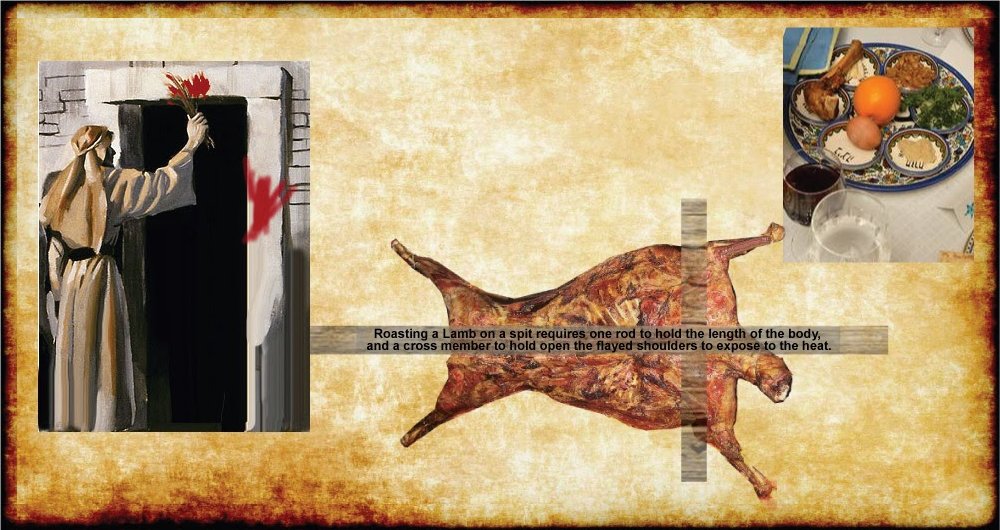
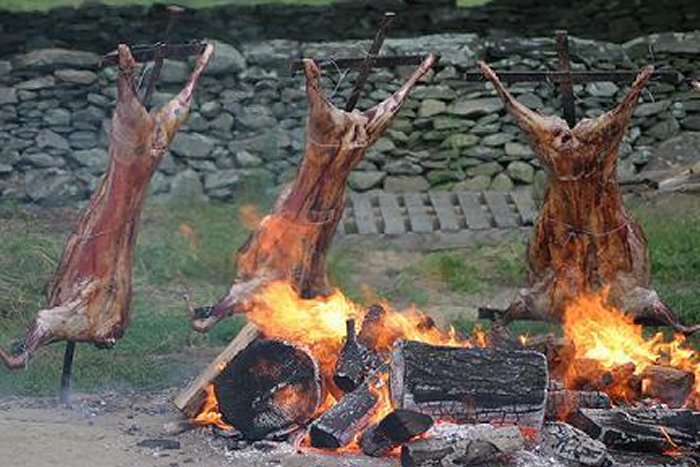
.That night after sunset, when Aviv 15 had begun, every family was to roast its lamb over a fire and eat it, along with bitter herbs and bread without yeast; it had to be fully cooked, even the inner parts .
At midnight (on Aviv 15, since the Hebrew day begins at sunset), the Lord allowed the “destroyer” (death angel) to strike dead the firstborn of every household in the land which did not have blood applied to the doorway
In every Egyptian dwelling (including Pharaoh’s palace), each firstborn son, as well as the firstborn of every kind of animal, was killed (Exodus 11:5, 12:12,29,30). However, no one in any Hebrew family, nor any of their livestock, was harmed (11:7, 12:13,23,27). When Pharaoh discovered that even his own firstborn son was dead, which was prophesied to happen (4:23), he finally told Moses to take the Israelites and their livestock and leave (12:31,32).
Sacrificing the Pesach or Passover lamb on Aviv 14 was a ceremony to be observed as a lasting ordinance for all subsequent generations
parallels between Jesus and the Passover lamb
In the time of Jesus, it was on Aviv 10
One passage being sung was, “Oh Lord, please save us, Oh Lord, please save us. Oh Lord, send us prosperity, Oh Lord, send us prosperity. Blessed is He that comes in the name of the Lord.” This was an expansion of the psalmic verses, “Oh Lord, save us; O Lord, grant us success. Blessed is he who comes in the name of the Lord”
Following the procession of the Passover lamb, Jesus made His final entrance from the Mount of Olives into Jerusalem on a donkey
The crowds of people, most of whom had witnessed or known of Jesus’ great miracles, placed more palm branches on the pathway ahead of Him (thus, the name “Palm Sunday”) and shouted to Him as He passed by, “‘Hosanna to the Son of David!’ ‘Blessed is he who comes in the name of the Lord!’ ‘Hosanna in the highest!’”
It was, and still is, a tradition to rid one’s home of leaven or yeast—representative of “sin”—prior to the Feast of Unleavened Bread. In essence, this is what Jesus did when He entered the temple, driving out all who were buying and selling and overturning all of the tables of the money changers
For four days, Israel’s primary Pesach lamb was kept in public view at the temple for everyone to examine to make sure that it was perfect and without defect. During the same four days, the chief priests, elders, Pharisees, and Sadducees interrogated Jesus; but He always left them speechless, because they could find no fault with His impeccable logic and character
Moreover, after Jesus was arrested, Pilate (governor of Jerusalem) and Herod (governor of Galilee) could find no evidence against Him nor fault with Him
The Passover lamb was to be sacrificed in the temple on Aviv 14 at “twilight”
The Passover lamb in the temple was bound to the altar at about 9:00 a.m. Similarly, “It was the third hour when they crucified [Jesus]”
It was about 3:00 p.m. that Jesus died
  |
Finally, it was forbidden for any of the Passover lamb’s bones to be broken
It might be added that it often took two or three days for a person to die on a cross. But it took Jesus—a strong, healthy man—only six hours to die. Besides the fact that he had been severely flogged and beaten beyond recognition
He knew that He had to keep the appointment of dying at the same time as the Passover lamb in the temple. He also had to leave time to be placed in the tomb before the Feast of Unleavened Bread, a “special” or “high” Sabbath (not the regular weekly Sabbath) began at sunset, since the Jews did not want any bodies left on the crosses during a Sabbath
The ancient prophet Isaiah, in all of
crucifixion not on Friday
Traditionally, it has been accepted that Jesus was crucified on “Good Friday.” The assumption for this is based upon the fact that, after Jesus’ death, the Jews asked that all crucified bodies be taken down from the crosses in respect for a “special” or “high” Sabbath, which began at sunset and continued through the next day
Because the usual weekly Sabbath began at sunset after Friday was over, traditionally it has been assumed that Jesus died on Friday. Had Jesus died on Friday, though, He would have been in the grave for portions of only 2 days (the rest of Friday and all day Saturday) and 2 nights (the beginning of Saturday and the beginning of Sunday—see the Holy Week chart). Thus, His own prophecy (“...the Son of Man will be three days and three nights in the heart of the earth”—
Actually, though, the Sabbath referred to in this case was one of the “special” or “high” Sabbaths occurring each year. This was a day on which a sacred assembly was to be held, and no regular work was to be done
The first day of the Feast of Unleavened Bread (Aviv 15), the “special” or “high” Sabbath under consideration, began at sunset after the day of Preparation (Aviv 14) had ended. This is the Sabbath on which the women rested after preparing spices and perfumes
The day on which Passover began (Aviv 14) was referred to as the “day of Preparation”
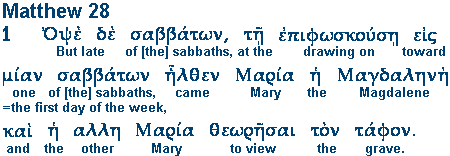
This further is inferred in Matthew’s account by the statement, “After the Sabbath, at dawn on the first day of the week...” (Matthew 28:1a). Here, “Sabbath” is a mistranslation into English; the Greek reads “Shabbaton”  ),
), ).
).
triumphal entry
Some will point out how, according to
In fact, the Passover meal was to be eaten at night
So this meal would have been eaten during the beginning (night) hours of Friday, a few hours after Jesus died at mid-afternoon on Good Thursday. Counting back 6 days, we arrive at Saturday, the day Jesus rode into Bethany:
day 6: Thursday (Yom Chamishi)Also, from a Hebraic perspective, a significant portion of a day could be considered to be a “day.” The period of Passover officially began at mid-afternoon on Aviv 14 (see the Passover and Related Periods chart). Therefore, a mid-afternoon death of Jesus on Thursday—which had begun at sunset, about 21 hours before that point—works out fine if the six days of
day 5: Wednesday (Yom Revi‘i),
day 4: Tuesday (Yom Shlishi),
day 3: Monday (Yom Sheni),
day 2: Sunday (Yom Rishon), and
day 1: Saturday (Yom Shabbat).
day 6: the 21 hours of Thursday (Yom Chamishi) prior to the slaughter of the Passover lambs (and death of Jesus) at mid-afternoon, which was the beginning of Passover,However, beginning the count backward at mid-afternoon on Friday does not fit, as the majority of Friday would have been counted as a “day.” This would result in seven days, not six days, being counted backward to Saturday, the day Jesus arrived in Bethany. That would violate what is stated in
day 5: Wednesday (Yom Revi‘i),
day 4: Tuesday (Yom Shlishi),
day 3: Monday (Yom Sheni),
day 2: Sunday (Yom Rishon), and
day 1: Saturday (Yom Shabbat).
Also, Yeshua/Jesus made His triumphal entry into Jerusalem on a donkey
Thus, Yeshua would not have been able to ride a donkey on Saturday, the Sabbath. Had He done so, He would have broken the Law/Torah—which He never did even once, since He was the living, breathing Torah (see Torah and Prophets).
Finally, Yeshua/Jesus was the ultimate Passover Lamb
Aviv 10: Sunday (Yom Rishon) when Jesus, the Passover Lamb for humanity, rode into Jerusalem,
Aviv 11: Monday (Yom Sheni),
Aviv 12: Tuesday (Yom Shlishi),
Aviv 13: Wednesday (Yom Revi‘i), and
Aviv 14: Thursday (Yom Chamishi) when Jesus was crucified at mid-morning and died at mid-afternoon.
three hours of darkness
Prior to Jesus’s death on the cross, there were three hours of darkness over all the land
However, it was about the ninth hour, at the end of the three hours of darkness, that Jesus gave up His spirit and died
 Moreover, those three hours of darkness were not "night," which explicitly is between evening and dawn. It is similar to how a new moon blocks out the sun during a solar eclipse. Although it is dark, it still is daytime, not nighttime, because the sun is not on the opposite side of the earth.
Incidentally, a solar eclipse is not what caused the three hours of darkness on crucifixion day, as some have suggested. There always is a full moon on Passover; but there must be a new moon, where the moon is between the sun and the earth, for a solar eclipse to take place.
The darkening of the sun for three hours, from the sixth hour (noon) to the ninth hour (mid-afternoon), must have been due to a supernatural act of God. Perhaps the Father, who cannot look upon sin, had to look away as the sin of the world was being placed on Jesus
With a Friday crucifixion, even if the three hours of darkness could be considered to be one “night” of the “three days and three nights” prophecy, then Jesus’ body would have been in the tomb or grave
Jesus rose from the dead on the first day of the week (Sunday) when it was dark. We know this because Mary Magdalene and the other Mary got to the tomb at dawn, having walked there while it was still dark, and saw that the stone had been rolled away
Passover and crucifixion on Thursday
first day of unleavened bread
Three Gospel accounts, as translated directly from the Greek, indicate that it was the “first day” or the “day” of unleavened bread—the same day the Passover lamb was to be sacrificed—when Jesus told Peter and John to go to a certain man in the city to arrange for them to eat the Passover meal at his house. Here are correct translations from the Greek of the first portion of each verse:
Now on the first [day] of unleavened bread... (Matthew 26:17).Here is the Greek for those two verses, with the direct translations into English:
And on the first day of unleavened bread... (Mark 14:12).
In many Bible versions, though, there is a mistranslation to English in the Matthew and Mark accounts:
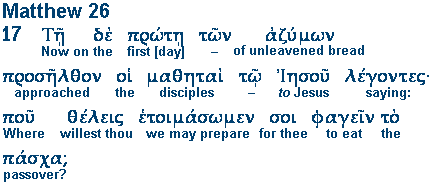
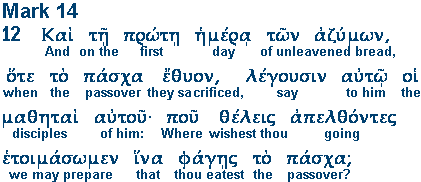
On the first day of the Feast of Unleavened Bread...In the original Greek, which is correct, the word “feast” is not present, nor is it implied, because this was not the first day of the Feast of Unleavened Bread. In fact, it would have made no sense for Jesus’ disciples, on Aviv 15, to prepare for the Passover, which began at mid-afternoon on Aviv 14.(Matthew 26:17; Mark 14:12).
On this Preparation Day (Aviv 14), all the preparations for the Passover and for the week of the Feast were made, including removing any leaven from the people’s homes. It also included mixing the unleavened dough (without yeast) and baking the bread, as well as slaughtering and roasting the Passover lambs. They would be eaten at the Passover meal that evening, after sunset. Not only was it permissible to eat unleavened bread during Preparation Day, it was (and still is) customary to do so, as there is no commandment against doing so.
Therefore, following the “day of unleavened bread” or Preparation Day, on which the unleavened bread was prepared, the actual Feast of Unleavened Bread technically did not begin until after sunset. This was just a few hours after the start of Passover at mid-afternoon (at “twilight”), when the lambs were slain. In other words, people could “snack” on unleavened bread as they were preparing the Passover meal during Preparation Day (Aviv 14); then the meal was eaten after sunset (Aviv 15), when the Feast of Unleavened Bread began.
In Mark’s account, the sentence continues, “...when it was customary to sacrifice the Passover lamb....”
Moreover, as noted in a previous section, on Aviv 15 a sacred assembly was to be held, and no regular work was to be done
In the third Gospel account, the translation from Greek to English is correct: “Then came the day of unleavened bread on which the Passover lamb had to be sacrificed”
It would have been acceptable to eat a little of the bread on this day (as there was no regulation prohibiting it), much as people might taste something they are making before it goes into the oven or have a small sample of it, after it is cooked or baked, before it is served at the evening meal. Then it was required to eat the unleavened bread, prepared on this day, for the next seven days during the week of the Feast of Unleavened Bread.
The fourth Gospel account correctly notes that the time was “...before the Passover Feast”
Last Supper
Jesus seemed to display a sense of urgency in saying that His appointed time to leave the world (that is, to be killed) was near
Some will insist that Jesus and His disciples ate their meal at the same time that all the other Jews ate the Passover, which would have been during the beginning hours of Aviv 15 (soon after sunset following Aviv 14). If that had been the case, then Jesus would have died on the cross the following afternoon, on Aviv 15, twenty-four hours after all the Passover lambs had been slain.
Yet, by examining two passages, it can be shown that the Last Supper was eaten during the beginning hours of Aviv 14, following sunset after Aviv 13. Firstly, it should be noted that Jesus dipped some bread and handed it to Judas Iscariot and told him, “What you are about to do, do quickly”; then Judas went out
However, some of the disciples thought that Jesus was telling Judas to go buy what was needed for the Feast (John 13:29)—that is, for the regular Passover Feast, which would not take place until the following night, soon after Aviv 15 began. Moreover, if Jesus and His disciples had been eating the regular Passover meal during the initial hours of Aviv 15, the disciples would have known that Judas was not going out to buy anything, since it would have been forbidden to do so on a special/high Sabbath. Thus, the Last Supper, on Aviv 14, was not the regular Passover Feast, which took place the following night on Aviv 15.
Secondly, a few hours after Jesus was arrested, He was led by the Jews to the palace of the Roman governor, Pilate, in the early daytime hours of Aviv 14. But none of the Jews entered the palace because doing so would have made them ceremonially unclean, and they would not have been able to eat the Passover
Jesus would have known that He would be unable to eat the traditional Passover meal the following night, as He knew that He would not be alive. Furthermore, even if Jesus had not been crucified, He would not have been able to eat the usual Passover meal the next night (Aviv 15), since He was Jewish in the flesh and would have become ceremonially unclean after having entered Pilate’s palace
bread
In the Spring, a Hebraic “day” began with darkness for about 12 hours and continued into daylight for the next 12 hours. So it would have been during the evening hours at the beginning of Preparation Day on Thursday, Aviv 14 (soon after sunset following Wednesday, Aviv 13), when Jesus instructed His disciples to go make preparations to eat the Passover meal, even though it was one night sooner than usual. The large upper room, where Jesus and the disciples ate their Passover Seder—the “Last Supper”—already was furnished and ready
One might wonder how the disciples, on such short notice, would have had the time to mix and bake unleavened bread for the evening meal. Unleavened bread was eaten only at that time of year and was not easily accessible without making it, which was not done until later on this Preparation Day. However, let us take a look at the following two verses:
And he took bread, gave thanks and broke it, and gave it to them, saying, “This is my body given for you; do this in remembrance of me”In both of these verses, the word for “bread” in the Greek is(Luke 22:19).
“I am not referring to all of you; I know those I have chosen. But this is to fulfill the scripture: ‘He who shares my bread has lifted up his heel against me’”(John 13:18).
 ),
),Interestingly, the bread eaten at this meal represented the body of Jesus
So the preparations for this evening meal would not have taken long; and the meal was eaten that very night, after Aviv 14 had begun, when the hour to eat had arrived
lamb
As to whether or not a lamb was eaten as part of the final meal (the Last Supper) that Jesus had with His disciples, the details are inconclusive. Certainly, there is no mention of a lamb having been slaughtered and prepared for this meal, nor having been eaten at the meal. We do know that bread and wine were consumed
Some might assume that the disciples’ preparations for the meal
Moreover, on some level, it would seem to be incongruous for Jesus to have eaten a slain lamb when He Himself was going to be slain, the following afternoon, as the Passover Lamb for Israel and for humanity as a whole. In fact, it would seem to have been superfluous and unnecessary, if not a manifest distraction, for an actual slain lamb even to have been present in the same room.
Paul said, “For Christ, our Passover lamb, has been sacrificed”
In essence, the true Passover Lamb, Jesus, was present; there did not need to be another lamb on the premises. In fact, in that context, it would seem to have been absolutely essential that the disciples’ Passover meal was eaten on Aviv (Nisan) 14, rather than 24 hours later on Aviv 15, when a roasted lamb certainly would have been an integral part of the standard Passover meal.
Passover and Feast of Unleavened Bread
Aviv 14 was Preparation Day, on which the lambs were slaughtered at mid-afternoon—that is, at “twilight” (which was not the same as sunset). It was at “twilight” that Passover began
On Aviv 15, a sacred assembly was to be held and no work was to be done
Passover was a covenant that God made with the Israelites. Their part was to slaughter their flawless, unblemished lambs on Preparation Day, Aviv 14, and to apply the blood of the lambs to the tops and sides of the doorframes of their homes
So “Passover” officially began when the lambs were slain at mid-afternoon (or “twilight”) on Preparation Day (Aviv 14) and ended at midnight on the first night of the Feast of Unleavened Bread (Aviv 15). Thus, Passover and the Feast of Unleavened Bread overlapped by about six hours. Traditionally, Aviv 15 is referred to as the “first day of Passover (or Pesach),” and the entire week of the Feast of Unleavened Bread often is referred to as “the week of Passover (or Pesach)”; however, these are not scriptural designations.
Passover and Related Periods
Beginnings and Conclusions
| Time Period | Begins | Concludes |
|---|---|---|
| Preparation Day | Sunset at the end of Aviv 13 |
Sunset at the end of Aviv 14 |
| Passover | Mid-afternoon on Aviv 14 |
Midnight on Aviv 15 |
| Feast of Unleavened Bread |
Sunset at the end of Aviv 14 |
Sunset at the end of Aviv 21 |
prophecy fulfillment
Jesus died at mid-afternoon (beyn ha’arbayim or “twilight”—about 3:00 p.m.) on Good Thursday (Aviv 14) at the very time the Pesach lamb was sacrificed in the temple. In Jesus’ prophecy
Thus, as soon as Jesus uttered the words “It is finished”
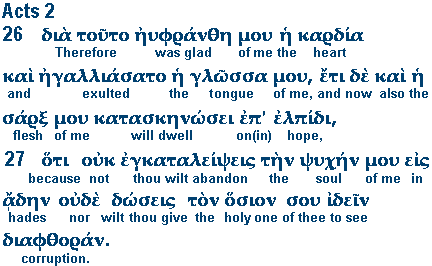
 ).
).Traditionally, a “day” could be any portion of a day and a “night” any portion of a night. Since the body of Jesus—who became a curse for us
This would have allowed Jesus to be resurrected sometime between sunset on Saturday (Aviv 16) and sunrise on the first day of the week
For as Jonah was three days and three nights in the belly of a huge fish, so the Son of Man will be three days and three nights in the heart of the earthSunday, Aviv 17, was the Feast of Firstfruits, as well as the day following the weekly Sabbath(Matthew 12:40) .
counting of the Omer
During the Feast of Unleavened Bread, a priest was to wave a sheaf of the first grain of the barley harvest on the day after the Sabbath
Some consider this particular Sabbath to be the first day of the Feast of Unleavened Bread, which was a “special” or “high” Sabbath (23:6,7). However, the Sabbath in question actually is the regular weekly Sabbath during that week. This can be shown by looking at this passage:
From the day after the Sabbath, the day you brought the sheaf of the wave offering, count off seven full weeks. Count off fifty days up to the day after the seventh Sabbath, and then present an offering of new grain to the LORDFollowing the week of the Feast of Unleavened Bread—during which there are two “special” or “high” Sabbaths, on both the first day and the last day(Leviticus 23:15,16) .
Therefore, the count of the seven weeks, up to Shavuot, Feast of Weeks, or Feast of Harvest, always begins on the first day of the week and ends on the first day of the week (Yom Rishon or Sunday). During Holy Week, day #1 of the count was on the day of Jesus’ resurrection, the Feast of Firstfruits (which usually, but not always, is “Easter Sunday”); and seven weeks later, day #50 of the count was on Pentecost. So with Jesus’ crucifixion taking place on Aviv 14, His resurrection took place on Aviv 17:
- Aviv 14: Preparation Day (Yom Chamishi or Thursday)
- Aviv 15: first day of the Feast of Unleavened Bread, a “special” or “high” Sabbath (Yom Shishi or Friday)
- Aviv 16: regular weekly Sabbath (Yom Shabbat or Saturday)
- Aviv 17: Feast of Firstfruits = Resurrection Day (Yom Rishon or Sunday)
crucifixion not on Wednesday
Some believe that Jesus was crucified on a Wednesday. Their foundational assumption is that the “three days and three nights” in the
There are several reasons why I am convinced that Jesus rose from the dead sometime after sunset on Saturday, Aviv 16, at which time Sunday, Aviv 17 (the first day of the week), had begun.
- Mark wrote, “When Jesus rose early on the first day of the week...”
(Mark 16:9). The first day of the week is Sunday, not Saturday. That means the earliest He could have risen was a moment after the previous sunset, which ended the seventh day (Saturday). He could not have risen anytime prior to sunset (and certainly not prior to dawn) on Saturday. Furthermore, we know that Jesus rose before the women reached the tomb.Matthew 28:1 andJohn 20:1 point to a resurrection prior to sunrise on the first day of the week, while it was still dark. Thus, Jesus had to have risen at some point during the nighttime hours of Sunday, before dawn. The hours of darkness on Sunday (which began a moment after sunset on Saturday and ended at daylight on Sunday), during which Jesus arose, were the third night of theMatthew 12:40 prophecy. Even if Jesus had been crucified on Wednesday and had been entombed during the dark hours of Thursday (following sunset on Wednesday), then He would have been “in the heart of the earth” during four nights, rather than three nights, thus contradicting His prophecy.
- Luke wrote, “Now on that same day [the first day of the week—
Luke 24:1], two of them were going to a village called Emmaus...” (24:13). Jesus came and walked along with them, asking them questions and getting them to talk about the events that recently had happened to Jesus, including the crucifixion (24:19b-21a). They said, “And what is more, it is the third day since all this took place” (24:21b). If they said this to Jesus on the first day of the week, and we count back three days, we move back to Thursday (not Wednesday or Friday) as His crucifixion day. Moreover, these men said that the women had gone to the tomb early that morning (24:22), which was the first day of the week (24:1).
- The women would have broken Levitical law if they had run to the tomb on a Sabbath day. Had Jesus been crucified and buried on Wednesday, then Thursday would have been a “special” or “high” Sabbath
(John 19:31a); and the women would not have been permitted to run to the tomb on that day. Presumably though, with a Wednesday crucifixion, they would have rushed to the tomb at dawn on Friday. If they did not have the spices they needed, they could have purchased and prepared them on Friday morning and gone to the tomb in the afternoon. Yet, they did not, because two Sabbath days in a row—Friday (a special/high Sabbath) and Saturday (the regular weekly Sabbath)—kept them away until Sunday morning. Thus, Jesus died on Thursday; and the next day (Friday) was the first day of the Feast of Unleavened Bread, a special/high Sabbath, with the following day (Saturday) being the usual weekly Sabbath. Then the women went to the tomb, with the spices they had prepared, on the first day of the week(Luke 24:1).
Leviticus 23:3 indicates that the seventh day of the week is the regular weekly Sabbath.Leviticus 23:9-14 describes the celebration of firstfruits, and the specific day for this to occur is seen to be the day after the regular Sabbath (23:11), making it be the first day of the week. Jesus fulfilled the four Spring feasts/festivals (Passover, Feast of Unleavened Bread, Feast of Firstfruits, and Shavuot) at His first coming. As the firstfruits from the dead(1 Corinthians 15:20,23) , Jesus fulfilled the Feast of Firstfruits by rising from the dead on that day—the first day of the week, which in that year was Aviv 17.
Paul said,
But Christ has indeed been raised from the dead, the firstfruits of those who have fallen asleep. For since death came through a man, the resurrection of the dead comes also through a man. For as in Adam all die, so in Christ all will be made alive. But each in his own turn: Christ, the firstfruits; then, when he comes, those who belong to himJesus was the firstfruits from the dead of all those who would rise and never would die again (see The Rapture). It is a fact that He fulfilled the Feast of Firstfruits by rising from death on that day. According to(1 Corinthians 15:20-23).
The Feast of Weeks, also known as Shavuot or Pentecost, was to take place seven weeks following the Feast of Firstfruits:
From the day after the Sabbath, the day you brought the sheaf of the wave offering, count off seven full weeks. Count off fifty days up to the day after the seventh Sabbath, and then present an offering of new grain to the LORD. From wherever you live, bring two loaves made of two-tenths of an ephah of fine flour, baked with yeast, as a wave offering of firstfruits to the LORDThat is, counting the day after the regular weekly Sabbath as day #1, then day #50 (seven weeks later) would be the day that they were to present another firstfruits offering. The latter was to be “the day after the seventh Sabbath”; that seventh Sabbath was a regular weekly Sabbath. Shavuot/Pentecost, when counted correctly, always is on a Sunday. Likewise, the Feast of Firstfruits (Resurrection Day) was, and is, on the first day of the week: Sunday.(Leviticus 23:15-17).
2) How do you know that Yeshua’s triumphal entry into Jerusalem wasn’t on a Saturday, rather than on the traditionally accepted “Palm Sunday,” which would have caused the crucifixion to be on Wednesday rather than on Thursday?
We know that the 10th of Aviv was when the Passover lambs were selected by the Israelites
It is true that the only way the 14th of Aviv could have fallen on a Wednesday was if Yeshua had ridden into Jerusalem
Thus, Yeshua would not have been able to ride a donkey on Saturday, the Sabbath. Had He done so, He would have broken the Law/Torah—which He never did even once, since He was the living, breathing Torah (see Torah and Prophets).
We know that the 14th of Aviv was when the Passover lambs were slaughtered
- Sunday (Yom Rishon), the 10th of Aviv
- Monday (Yom Sheni), the 11th of Aviv
- Tuesday (Yom Shlishi), the 12th of Aviv
- Wednesday (Yom Revi‘i), the 13th of Aviv
- Thursday (Yom Chamishi), the 14th of Aviv
3) Do we have any Scripture to confirm whether Christ arose before or after midnight on Sunday?
No, but a Hebrew day runs from sunset to sunset (not midnight to midnight). As long as He rose at some point after the previous sunset, which was the beginning of Sunday (and which began the final night of the “three days and three nights” sequence), then He rose on the first day of the week. It doesn’t matter whether He rose before or after midnight; either way, it still was during the hours of darkness on the first day of the week, satisfying the third “night” of the
4) Doesn’t Jesus’ prophecy, “For as Jonah was three days and three nights in the belly of the a huge fish, so the Son of Man will be three days and three nights in the heart of the earth”
Traditionally, any portion of a day or night was considered to be a “day” or a “night.” There is no stipulation anywhere indicating that Jesus had to have been “in the heart of the earth”
We know that it was the ninth hour of daylight (about 3:00 p.m.) that Jesus died
If Jesus died at 3:00 p.m. on Wednesday, and assuming the 72-hour time limit, then the latest Jesus could have risen would have been at mid-afternoon on Saturday. Surely, the guards (and others nearby) would have been awake during daylight hours and would have seen the stone rolled away. Yet, all of that is irrelevant; Jesus could not have risen on Saturday because He rose on the first day of the week
Even without the 72-hour time constraint, if Jesus had died at about 3:00 p.m. on Wednesday and had risen sometime after sunset on Saturday, this would have comprised parts of four days and four nights (the remainder of Wednesday, all night and all day Thursday, all night and all day Friday, all night and all day Saturday, and the beginning of the night on Sunday), nullifying Jesus’ prophecy. Thinking that “three days and three nights” must be equivalent to “72 hours” of time, in my opinion, is an attempt to force Jesus’ prophecy to comply with one’s personal preferences and assumptions.
If I say, “I visited my friend in the hospital yesterday and last night,” it most likely does not mean that I had to have been there from dawn yesterday morning to dawn this morning—one entire day and one entire night or 24 hours. In fact, anyone listening to me most likely would have assumed that I was not there that entire time. I could have gone there at 9:00 a.m. and left at 11:00 a.m., then gone again at 6:00 p.m. and left at 8:00 p.m., which meant that I was there only part of a day and part of a night.
Jesus died on Thursday at about 3:00 p.m. (at “twilight”—halfway between the minor evening oblation, from noon to 3:00 p.m., and the major evening oblation, from 3:00 p.m. to 6:00 p.m.). Since He would have had to have been buried prior to sunset (which began the first day of the Feast of Unleavened Bread, a “special” or “high” Sabbath—
Isaac was a “type” of Jesus. In the eyes of God, Isaac was Abraham’s only legitimate son
The next morning (the first day after the commandment for Isaac to die), Abraham saddled his donkey and left with Isaac and two servants
How could Abraham believe that they both would return if Isaac would be dead? Abraham believed that if he were to follow through with sacrificing Isaac, God could resurrect him—which, figuratively speaking, He did
We do not know on which day of the week God commanded Abraham to sacrifice Isaac; but, for a moment, let us assume that it was a Thursday. Figuratively speaking, that was the day of Isaac’s sacrifice and death, because God had commanded it, and only God can rescind His own command.
It was the next day—the first day after the command to sacrifice Isaac—that Abraham and Isaac set out for Moriah. On our proposed time line, this would have been Friday. The second day, Saturday, was a travel day. Then it was on the third day that Isaac’s reprieve from God came; and Isaac, in effect, was raised from death
Holy Week

Ted’s Bible Commentaries
and Other Links

)
Comments or questions? Email Me.

Copyright © 2004– by Ted M. Montgomery, O.D. Most rights reserved.
THE HOLY BIBLE, NEW INTERNATIONAL VERSION®, NIV®
Copyright © 1973, 1978, 1984, 2011 by Biblica, Inc.®
Used by permission. All rights reserved worldwide.