Summary of Commentaries
overview
Traditional Christian tenets and doctrines are foundational within the Catholic and Protestant Churches. I have come to be convinced, though, that many things widely accepted as fact by the modern Church, indeed, are not true at all.
As such, I have written several commentaries in which I have pointed out some traditional views that I believe are erroneous. I also have taken the time, using scores of scriptural references, to propose and explain optional views. Links to these commentaries are here:
In each section below, I will include the information taken from the Overview section of each of the eleven commentaries, for easy reference.
Who Is God?
Can we really know God? This has been one of the most frequently-asked questions, at least by those who believe in God, since the inception of humankind. I am certain that the answer to this question is, emphatically, YES! It is possible for those who have faith in the existence of God to be able to experience the greatest relationship in the universe, on an ongoing basis.
Not only did God create the entire universe and everything in it (see The Creation), but He did it, I believe, primarily for one purpose: to communicate and commune, on a personal, intimate level, with those people who would choose to communicate and commune with Him. Eventually, He will take them to be with Him in the incomprehensibly wonderful realm of the brand new, perfect universe, which He will create after this present one has passed away
Thus, if God indeed has created all that we see and know, and ultimately will create again all that there ever will be, it is important for us, as humans—the greatest examples of His handiwork—to know that He exists and, beyond that, to know as much about Him as possible. For instance, is the main “god” of every religion the same God? I believe not, although I realize that much of the world would disagree.
The God who has created (and once again will create) everything that there is (or ever will be) is One God with multiple, and I suspect infinite, “facets.” At least three of these facets have been made known to mankind. I believe that there are innumerable “sides” or “aspects” of God of which we know nothing about. Our finite minds simply cannot grasp or comprehend His infinite nature. We cannot even fathom all of the names and attributes of God that we know about.
Within the Triune composition of God, about which we know, each of the “components” is intimately associated and connected with the other two—a “closed system” of intimacy, as it were. This Triune Nature always has been, and always will be, in existence; and there always has been and always will be absolute, unvarying unity, harmony, communication, and agreement among all three Members.
Was Jesus God?
Some believe that Jesus was God, and others believe that He was merely a man. Many believe that He was both. These views have been debated for centuries by theologians and scholars. I think it is vital to look at what the Bible—the Word of God—says about the matter.
Many people believe that Jesus never actually claimed to be God. Personally, I feel that most people who believe this, themselves, simply do not want to believe that Jesus was/is God; and they use the invalid statement, “Jesus never claimed to be God,” as alleged “support” for their lack of belief (and lack of careful study of the Gospel accounts).
Firstly, as the Messiah or Servant appointed by the Father to accomplish His Plan of salvation for mankind
Secondly, the enemies of Jesus recognized, through His many statements, that He claimed to be God. Certain people are our enemies because they vehemently disagree with what we represent or espouse. And that is why Jesus’ enemies hated Him, not even realizing—or, rather, refusing to take the time to comprehend—that He had something to offer them which would have infinitely and eternally positive payoffs.
Good Thursday
The days of the week have different names on the Hebraic calendar and on the Roman calendar. The following chart shows both sets of names; however, for ease of understanding, the Roman days of the week will be used throughout this commentary:
Days of the Week
Hebrew Names and Roman Names
| Day Number | Hebrew Name | Roman Name |
|---|---|---|
| First Day | Yom Rishon | Sunday |
| Second Day | Yom Sheni | Monday |
| Third Day | Yom Shlishi | Tuesday |
| Fourth Day | Yom Revi‘i | Wednesday |
| Fifth Day | Yom Chamishi | Thursday |
| Sixth Day | Yom Shishi | Friday |
| Seventh Day | Yom Shabbat | Saturday |
In ancient Israel, including during the first century A.D., preparations for the Pesach or Passover feast took place on “Preparation Day.” In the middle of the afternoon (that is, at beyn ha’arbayim, often referred to as “twilight”) on that day, the Passover lamb was sacrificed at the temple in Jerusalem. After sunset, when Preparation Day had ended and the Feast of Unleavened Bread had begun, the lamb and other specific foods for the Pesach feast were eaten.
Jesus was crucified and died on Preparation Day. Traditionally, this has been thought to have been on a Friday. I would like to demonstrate that Jesus’ crucifixion and death occurred not on a Friday (the sixth day of the week), as has been traditionally accepted, but rather on the previous day, Thursday (the fifth day of the week).
At that time, the days of the week were referred to as the “first day,” the “second day,” the “third day,” and so on, rather than as Sunday, Monday, Tuesday, etc., which were named after various gods. For ease of understanding by the “Western” mind, though, I will refer to the days of the week as we do today.
My Holy Week chart displays my depiction of the week during which the following occurred in the month of Aviv (also called Nisan) of that year:
- Jesus entered Jerusalem riding on a donkey (on Palm Sunday, Aviv 10), as prophesied in
Zechariah 9:9; - He was crucified four days later (on Thursday, Aviv 14); and
- He was resurrected from the dead on the third day after that (on Sunday, Aviv 17).
Some believe that Jesus was crucified on a Wednesday. The crucifixion not on Wednesday section demonstrates why I am convinced that this was not the case. The “three days and three nights” in the
The Chronology of Revelation
One of the principal keys to understanding the Book of Revelation is the chronology which takes place in its amazing chapters. Many outright misinterpretations of end-time events have resulted from not recognizing the proper sequencing of several passages in this remarkable and momentous prophetic book.
In some analyses of Revelation, “cutting” certain so-called “parenthetical” passages and inappropriately “pasting” them at other locations is a common practice. Often, this is done in an attempt to “prop up” inconsistent viewpoints. Therefore, I would like to present my interpretations of this great prophetic book by pointing out what I feel is a logical and rational chronology or time-sequencing of Revelation.
I am confident that every detail in the Book of Revelation will come to pass, just as the disciple/apostle John foresaw. I do not believe that these events already have come to pass, in past centuries, as some suppose. However, I do believe it is possible, even likely, that many events in the Bible (including some in Revelation) have dual or even multiple occurrences of fulfillment, both in the past and yet in the future.
Although many of the depictions in the Book of Revelation are symbolic, most of the book describes literal future events—as extraordinary and incredible as they might seem. Discerning the difference between the symbolic and the literal is important and, at times, challenging.
Those who never have read through the Book of Revelation might want to do so, either before or after reading this rather lengthy commentary. Revelation is the only book of the Bible to which a blessing is promised to those who read it and take to heart what is written in it
The reader also might wish to examine the Brief Chronology of Revelation to have in mind a general perception of the sequencing of this complex book, which I will explain in greater detail in Parts 1, 2, and 3 of this commentary. Also, see the bottom of The Chronology of Revelation—Part 3 page to view a graphic table showing some of the passages in Revelation (as well as a few passages from Matthew and Daniel) and when I believe they will occur, during the “70th Week.” The following table, also, might be helpful.
Brief Chronology of Revelation Chart
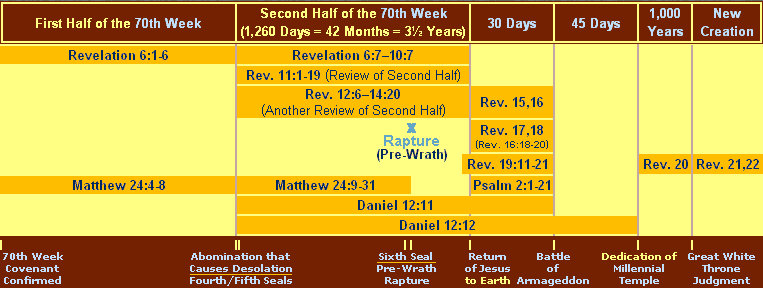
The Rapture
The topic of the Rapture is a controversial subject in Christian circles. There are five main Rapture views: Pre-Tribulation, Mid-Tribulation, Post-Tribulation, Pre-Wrath, and Multiple Raptures. The Rapture involves the concepts of “changed bodies,” as well as being “caught up” in the air to be with Jesus, from that point forward. Before you continue, you may want to read Corrie ten Boom on the Tribulation and the Rapture and Ruth B. Graham on the Pre-Tribulation Rapture. Both of them warned believers not to expect to be exempt from tribulation and persecution.
Although there are numerous biblical passages describing or referring to the Rapture event, probably the two most descriptive passages are
A widely-accepted theory is that of the Pre-Tribulation or “Pre-Trib” Rapture. This is based on the belief that the Rapture event (that is, the catching up of all those who maintain a belief in Jesus Christ as Lord and Savior) will take place just prior to the final seven years of this age (also referred to as the 70th Week, and often called the “tribulation” period). See “Pre-Trib”: My Prior View.
To help determine the point during the 70th Week at which the initial, primary Rapture event will occur, it first is helpful to determine the points at which other events are known or presumed to occur. Then, this collection of scripturally-sound information becomes a solid foundation on which to build the Pre-Wrath theory—which, I feel, demonstrates the proper timing of the main Rapture. My detailed chart, The 70th Week and Extensions, at the bottom of Part 2, shows my placement of the Pre-Wrath Rapture during the 70th Week.
The Endtimes
As the world’s attention becomes directed more and more toward ongoing hostilities in the Middle East, many will wonder what implications these events may have for the world’s future. No one, of course, can know precisely what the future holds. However, the Bible, more than any other book ever written, gives consistent guidelines leading to an overall understanding of what is yet to occur and how it will unfold.
There are some reading this commentary who
- do not believe that the Bible is a book of truth, or
- basically believe in the Bible’s truthfulness but do not believe that predictions about the future are literal, or
- do not want to hear unpleasant news about things that can and probably will affect them adversely, at some point in the future.
However, many of Nostradamus’ prophecies have turned out to be wrong; whereas, the Bible, so far, has a 100% accuracy rate when it comes to predicting things yet to happen. So it really is better to go to the Bible, the Word of God, to get a valid view of events on the future horizon. Further prophetic details can be found in some of my other Bible Commentaries.
I believe that the final seven years of this age, commonly referred to as the 70th Week, constitute the period of time during which these events will occur. I am convinced, as never before, that recent and current happenings indicate that this period of time, as prophesied in the Bible, is very near.
The Final Battles
At the end of the 70th Week (the final seven years of this age), Jesus the Messiah (Christ) will return to earth to rule and reign. It commonly is believed that, at that time, He will attack and destroy the armed forces of the Antichrist at the Battle of Armageddon. Although this encounter will occur, it can be demonstrated, by carefully examining Scripture, that it will not happen as soon as Jesus returns but, rather, soon thereafter (that is, a month later).
Concerning the day on which the armies of Gog/Magog are eliminated, the prophet Ezekiel wrote this:
From that day forward the house of Israel will know that I am the LORD their GodIn the past, there have been times when Israel acknowledged the Lord their God. However, never “from that day forward” have they maintained a constant acknowledgement and acceptance of the Lord their God. Instead, they always have back-slidden away from God, and much of Israel is in that condition today.(Ezekiel 39:22).
Therefore, it makes little to no sense that the prophecy in
The armies Jesus will “trample,” like grapes in a winepress
At that time, Jesus will be on His throne in Jerusalem as King over the whole earth
The Beasts
In the Old Testament prophetic Book of Daniel, King Nebuchadnezzar was described to have seen a large statue in a dream. Only the Jewish prophet Daniel was able to interpret the dream. Later, Daniel himself had a dream about four beasts; his dream paralleled Nebuchadnezzar’s dream. The parts of the statue, as well as the beasts, were found to represent kingdoms or nations upon the earth—the first of which existed at the time, and the remainder of which, eventually, would arise.
In the New Testament prophetic Book of Revelation, John described two other beasts which would arise (see also the lengthy commentary, The Chronology of Revelation). I believe these latter two beasts will be prominent relatively soon in the future of this world, near the “end of the age.” Furthermore, I suspect that their identities will be surprising to most. The beasts represent kingdoms or nations which have had, or will have, domination over the nation of Israel.
The beasts also will be representative of supernatural spiritual entities (also known as “princes”) and human leaders (also known as “kings”) who rule over nations or conglomerates of nations around the world. The prophesied righteous “seed” has passed through Abraham and the nation of Israel/Judah to the ultimate Messiah, Jesus Christ
The Creation
Both the belief that life on earth was started by God (“creation”), and the belief that life began on its own and evolved into higher life forms over a long period of time (“evolution”), are hotly-contested issues. Even within the sphere of creationism itself, there are two major debates: whether God created the universe, earth, plants, animals, and people in six, literal 24-hour days (“young-earth” view), or whether He created all of it in six long epochs or “age-days” of time (“old-earth” view). The main controversy concerning the timing of the Creation seems, primarily, to revolve around the meaning of the word “day” (which, in Hebrew is yôm) in
I understand the “young-earth” view of the universe and earth very well. Since I believe it is very important for people to understand all sides of any issue, I have studied the writings of those who strongly and adamantly advocate the young-earth perspective. With an open mind, I also have viewed 8 hours of young-earth DVDs by Ken Ham and 8 hours of young-earth DVDs by Kent Hovind. However, nothing has changed my belief in a very ancient universe and earth. If anything, my point of view about the Creation issue has become even more firm and steadfast.
Paradoxically, most young-earth creationists and evolutionists have in common one significant assumption: that evolutionary changes require a very long period of time to take place. Since the young-earth creationists who feel this way think that evolution might have occurred if the earth were very old, then they must reject the possibility that the earth could be old. Evolutionists, virtually all of whom believe in an old universe and earth, feel that a few billion years were sufficient for macroevolution, from species to species, to take place.
The fact is, spontaneous macroevolution is impossible no matter the age of the earth—even if it were trillions of years old. In addition, life could not have arisen out of nothing, nor even out of a “primordial slime,” without having been brought into existence by the supernatural Hand of a Being with infinitely greater intelligence than our own. Some call this Being an “Intelligent Designer”; I call Him God, the Creator of all things.
Another view is the “gap” theory, which suggests that God created everything in Genesis 1:1. Then Satan and fallen angels ruined everything that God had created. There ensued a “gap” of time of indeterminate length—perhaps several million years—until God decided to restore, repair, and reinstate everything, beginning in Genesis 1:2, which He did during a short creative week. I steadfastly reject this notion. My views about this are reflected very effectively in Closing the Gap: A Scientist’s Response to the Gap Theory.
I believe that God, the Creator, created the entire seen and unseen universe and everything in it—including the heavens and the earth, as well as all life. As such, the remainder of this commentary will deal mainly with my views of and ideas about the Creation. Other related issues, as well as outside sources regarding Creation and Evolution, are included in the final two sections, other issues and other sources, of Part 2. For those who feel that the first two chapters of Genesis have points of contradiction between them, read Genesis 1 vs. Genesis 2.
God’s Covenant: with Israel or the Church?
Has God permanently rejected Israel and, instead, embraced the Church of believers in Jesus Christ as His chosen people? There are many Christians who feel this way, supposing that Christendom has “superseded” or “replaced” Israel as the chosen people of God. This point of view is known as “replacement theology” or “supersessionism.” Generally speaking, here is their thinking about this, much of which is correct:
All of the points above are valid except for the last one. We will go through each valid point and then see what logical conclusions can be reached.

Other Links

Comments or questions? Email Me.
THE HOLY BIBLE, NEW INTERNATIONAL VERSION®, NIV®
Copyright © 1973, 1978, 1984, 2011 by Biblica, Inc.®
Used by permission. All rights reserved worldwide.