Why do you use the NIV, rather than the KJV, for the Bible references in all of your commentaries? Isn't the NIV negligent in showing whom Jesus really was?
I see you study/read the New International Version (NIV) of the Bible. I read that the NIV was adapted and came under the formation of the Roman Catholic Bible, which obviously differs from the original Greek. Also, http://www.av1611.org/niv.html explains that the NIV is not consistent in showing who Jesus really was. Why have you chosen the NIV over the King James Version (KJV) of the Bible?
Ted's Response:
I know that many people are staunch advocates of the King James Version (KJV) of the Bible and would never consider even glancing at another Bible version, which is fine. I sometimes look at the KJV at BibleGateway.com, along with other Bible versions, to make comparisons of certain words, phrases, verses and passages. Often, the KJV provides a good and plausible rendering of the word, phrase, verse or passage.
The Textus Receptus was the main Greek text from which the New Testament was derived, until the late 1800s. The King James Version and New King James Version came from this text. The Critical Text of the New Testament draws from a group of ancient Greek manuscripts and their variants. The New International Version, New American Standard Bible, English Standard Version, and most other modern Bible translations are based on this text. A brief summary of this can be found on these pages:
There have been, and continue to be, ongoing debates about Textual criticism and the Textus Receptus. There are positive and negative aspects of both. A lengthy discussion of the two, by Douglas Kutilek, can be found here: Westcott & Hort vs. Textus Receptus: Which is Superior?What you have read at http://www.av1611.org/niv.html was written by someone who adamantly advocates the KJV over the NIV. There even are claims that the NIV is a "perversion" of the Word of God.
Yet, in the New Testament, I can show you many cases of how it actually is the KJV that differs more from the Greek text than the NIV does. Below, I will comment on four such examples, which I have copied and pasted directly from the http://www.av1611.org/niv.html web page that you brought to my attention.
Incidentally, there are different translations from the Greek that are used by various versions of the Bible. I utilize the Zondervan Parallel New Testament in Greek and English, ninth printing 1986, although there are various source texts that are used for various Bible translations. In the one I use, one sentence in the Introduction states, "The text is based on a comparison of the texts edited by Tischenforf (1869-72), by Westcott and Hort (1881), and by Bernhard Weiss (1894-1900)."
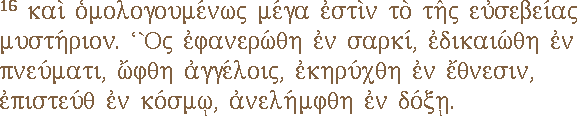
1) I TIMOTHY 3:16: The clearest verse in the Bible proclaiming that Jesus Christ was God. The King James Bible (KJB) reads, "And without controversy great is the mystery of godliness: GOD WAS MANIFEST IN THE FLESH. . ." The King James says, plainly, "GOD was manifest in the flesh". The NIV reads, "HE appeared in a body". The NIV "twists" "GOD" to "HE". "HE appeared in a body"? So What? Everyone has "appeared in a body"!"He" is a pronoun that refers to a noun or antecedent. There is no antecedent in the context! The statement does NOT make sense! The NIV subtilty (see Genesis 3:1) perverts I Timothy 3:16 into utter nonsense!
Here is 1 Timothy 3:16 in the Greek:
This is the direct translation, from the Greek, of that portion of 1 Timothy 3:16: "And confessedly great is the mystery of piety: Who was manifested in flesh...."
The Greek word Hos ( ) is the word "Who" or "Which"; it is not correctly translated as "God." The NIV's choice of "He" is closer to "Who" (in the Greek) than the KJV's choice of "God." But even if the reader does not make the connection, there is a footnote reference for that word that reads, "Some manuscripts God." So the NIV even points out that other versions (such as the KJV) read "God," even though it is not in the original Greek.
Furthermore, verse 15, the verse just previous to verse 16, reads this way:
If I am delayed, you will know how people ought to conduct themselves in God's household, which is the church of the living God, the pillar and foundation of the truth. (1 Timothy 3:15)Clearly, Paul was talking about God. Most people who read verse 16 in the NIV and wonder whom "He" is automatically would back up one verse to see whom Paul is calling "He" and see, in verse 15, that it is God. In doing so, readers also would be gaining more information and knowledge about God and His household, the Church.
The critic of the NIV has removed verse 16 from the framework and context of the whole passage, isolated it, judged it by his austere standards, and attempted to slaughter it. Yet, the verse remains alive and well for anyone who is perceptive and wise enough to read the entire written section within which it is contained.
It should be pointed out that there are New Testament passages indicating that Jesus is God, in the original Greek, for which the NIV provides a better rendering than the KJV. One example is John 1:18 (along with which I will include verse 17):
This is the direct translation, from the Greek, of John 3:17,18: "Because the law through Moses was given, the grace and the truth through Jesus Christ became. God no man has seen ever; [the] only begotten God the [one] being in the bosom of the Father, that one declared [him]."
Here is how the KJV and NIV, respectively, translate verse 18:
No man hath seen God at any time; the only begotten Son, which is in the bosom of the Father, he hath declared him. (John 1:18—KJV)The NIV includes further footnoted information:
No one has ever seen God, but God the One and Only, a,b who is at the Father's side, has made him known. (John 1:18—NIV)
a Or the Only BegottenFrom verse 17, it is clear that the person about whom the passage is speaking is Jesus Christ. In verse 18, the Greek shows that it is the "only begotten God" who declares the Father, so the original Greek text specifies that Jesus, who is God, is the one who does this. Likewise, the NIV, referring to Jesus, says that "God the One and Only" is the one who makes the Father known.
b Some manuscripts but the only (or only begotten) Son
On the other hand, the KJV indicates that it is the "only begotten Son," not the "only begotten God," who declares the Father. A reader might infer that Jesus, the Son, is God; but the KJV does not say so explicitly.
The NIV teaches in this case, as well as in abundant other places, that Jesus, without question, was God manifested in flesh. Was Jesus God? In reading the NIV, there should be no question that He was and is.
2) LUKE 2:33: The King James Bible reads, "And JOSEPH and his mother marvelled at those things which were spoken of him." The NIV reads, "The CHILD'S FATHER and mother marveled at what was said about him." The "CHILD'S FATHER"? Was Joseph Jesus's father? Not if you believe the virgin birth! Not if you believe John 3:16, that Jesus Christ was the Son of God! A subtil, "perversion" of the virgin birth.
Here is Luke 2:33 in the Greek:
This is the direct translation, from the Greek, of Luke 2:33: "And was the father of him and the mother marvelling at the things being said concerning him."
Again, the NIV's translation, "child's father," is a more correct translation of the Greek than the KJV's translation, "Joseph." There is not some conspiracy by whoever wrote the NIV, nor by the Catholic Church, in wanting to mislead people into thinking that Joseph was Jesus' biological father. If anyone believes in Jesus' virgin birth by Mary, whom they exalt very highly, it is the Catholic Church (which is not to say that I agree with all of the tenets of the Catholic Church because I do not).
The KJV is correct in identifying Joseph as being the person to whom that verse refers. However, it is incorrect in it's exact translation from the Greek. Interestingly, all but the KJV and NJKV omit the word "Joseph" in Luke 2:33, and that is because "Joseph" is not in the original Greek. Even in the NKJV, there is a notation that NU Text reads "And His father and mother." So, as far as I have seen (although I did not search every possible translation from the Greek), the KJV is alone in using the word "Joseph" in that verse and in not explaining to the reader that in the Greek, from which it was translated, that word is not there.
Notice these other verses in Luke chapter 2 of the KJV:
Now his parents went to Jerusalem every year at the feast of the passover. (Luke 2:41)
And when they saw him, they were amazed: and his mother said unto him, Son, why hast thou thus dealt with us? behold, thy father and I have sought thee sorrowing. (Luke 2:48)
In the first case, it is implied that Joseph was one of Jesus' parents. In the second case, even Mary implies, to Jesus, that Joseph is His father. So for those who argue that the KJV always and invariably indicates that Jesus is the Son of only God the Father (as I have heard some KJV advocates claim), and not the son of Joseph, these appear to be at least two exceptions in the KJV itself.
For someone learning about Jesus for the first time, and reading the KJV, both of these verses, all by themselves, would seem to imply that Jesus was the son of Joseph rather than the Son of God. Of course, believers understand that Jesus was not the biological son of Joseph; but new readers might get the wrong impression, from the KJV, in these particular cases.
Also, for someone reading the first three chapters of Luke, in any version of the Bible, and translated from any Greek text, it should be crystal clear (for instance, in Luke 1:27-32) that the text states that Jesus was born of a virgin and was the Son of God. Due to all of this, I find it an irrelevant and immaterial argument for anyone to focus on Luke 2:33, "nitpicking" and "splitting hairs" about the fact that the KJV is unique in not implying that Joseph was Jesus' biological father, and attempting to discredit other versions which, in their opinion, insinuate that he was.
Incidentally, I absolutely do believe in the virgin birth of Jesus. He is both the Son of Man and the one and only Son of God. (See also If Jesus was God, why did He say the Father was greater than He and knew things He didn't? and In John 3:16, isn't "only begotten" Son in the KJV the correct translation, whereas "one and only" Son in the NIV is an inaccurate translation?) Also, although Jesus was not the biological son of Joseph, He was Joseph's legal son, which was significant and important. (See Is Jesus a descendant of both David and Solomon?)
3) COLOSSIANS 1:14: The KJB reads, "In whom we have redemption THROUGH HIS BLOOD, even the forgiveness of sins:" The NIV reads, "In whom we have redemption, the forgiveness of sins." The NIV rips out the precious words "THROUGH HIS BLOOD"! Friend, redemption is ONLY "THROUGH HIS BLOOD". Hebrews 9:22, reads, ". . . without shedding of BLOOD is no remission." That old song says, "What can wash away my sins, NOTHING BUT THE BLOOD OF JESUS!"
Here is Colossians 1:14 in the Greek:
This is the direct translation, from the Greek, of Colossians 1:14: "...in whom we have the redemption, the forgiveness of the sins."
In the original Greek, the phrase "through his blood" is not there. Some versions, such as the KJV, have added it, probably taking it from Ephesians 1:7. The NIV even includes a footnote reference here that reads, "A few late manuscripts redemption through his blood."
Thus, the KJV adds something to the original word of God. Even if what it adds is a true statement, it is better to let the Word of God speak for itself and not add nor take anything away from it.
The NIV, on the other hand, translates the original text more accurately. Furthermore, with the footnote reference, it certainly does not abandon the principle that redemption is obtained only through the blood of Jesus, which is absolutely true.
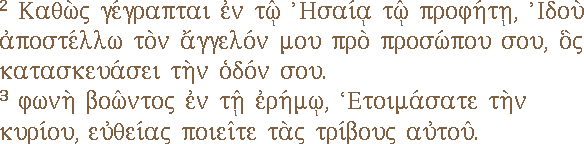
4) The NIV perverts Mark 1:2,3 into a LIE! The NIV reads "It is written in Isaiah the prophet: I will send my messenger ahead of you, who will prepare your way-a voice of one calling in the desert, Prepare the way for the Lord, make straight paths for him." It is NOT written in Isaiah! "I will send my messenger ahead of you, who will prepare your way" - is found in Malachi 3:1! The King James correctly reads: "As it is written in the PROPHETS, . . ." A better translation! Easier to read - BY A LIE!
Here is Mark 1:2,3 in the Greek:
This is the direct translation, from the Greek, of Mark 1:2,3: "As it has been written in Isaiah the prophet: Behold I send the messenger of me before the face of you, who will prepare the way of you."
In advocating the "correctness" of the KJV, the claim is that the reference to the prophet Isaiah should not be there. This is absolutely FALSE. In the Greek above, the fifth word in Mark 1:2 ( ) is translated "Isaiah." If the word Isaiah actually is in Mark 1:2 in the Greek text, then it is incorrect to remove it, as the KJV does.
In the NIV, a footnote reference after Mark 1:2 points to Malachi 3:1, and a footnote reference after Mark 1:3 points to Isaiah 40:3. Those are the two prophets, Malachi and Isaiah, to which the KJV refers when it reads, "As it is written in the prophets...." However, the KJV fails to make this connection, whereas the NIV is clear about the connection. Here are those two referenced verses, by the prophets, in the NIV:
"See, I will send my messenger, who will prepare the way before me. Then suddenly the Lord you are seeking will come to his temple; the messenger of the covenant, whom you desire, will come," says the LORD Almighty. (Malachi 3:1)In Isaiah's passage, the NIV includes further footnoted information:
A voice of one calling: "In the desert prepare the way for the LORD a; make straight in the wilderness a highway for our God" b. (Isaiah 40:3)
a Or A voice of one calling in the desert: "Prepare the way for the LORD"The NIV abounds in footnoted text, making sure that the reader is informed about all available interpretations and information. For instance, in the New Testament, there are countless references to Old Testament verses. This is vitally important in understanding how Christianity is the clear, natural, and unmistakable progression and unveiling of Judaism. On the other hand, I never have seen a KJV with any footnotes.
b Hebrew; Septuagint make straight the paths of our God
People who use a hostile and antagonistic approach to promote a point of view (as Terry Watkins does in his "New International Perversion" commentary) often do so either 1) because they are completely ignorant of the facts and/or 2) because they want to elicit an emotional reaction (usually rage) in their readers/listeners to gain support for their views.
Usually, they have "grown up" accepting something to be true or proper. They are comfortable with their viewpoint, which generally is accepted by others close to them as well. They typically have no interest in changing the way they think, even if evidence to the contrary is presented to them. Furthermore, they will employ any means to defend their position, because they cannot stand to be wrong and are intolerant of what other well-informed and well-meaning people believe.
Countless verses in the KJV begin with the word "and"; reading a protracted chain of such verses in a row is like reading one exceedingly lengthy sentence. Pertaining to punctuation, such sentences often will contain several incorrect comma splices. This can result in less comprehension of what was just read because the human brain better organizes single ideas rather than an entire collection of ideas put together as a unit. Millions of Christians have become accustomed to these drawn out groupings of verses that are commonplace in the KJV, even though modern English does not read that way at all.
KJV users also have become familiar with common phrases and passages from the KJV that they have read, and have heard being read, most of their lives. They have become "cozy" with words such as "thee," "thy," "thou," "ye," "shalt," "wilt," "hath," "hast," "hence," "thence," "goeth," "cometh," "exorteth," "saith," "heareth," and "repenteth." They even have come to associate such words with religiosity and holiness, if not with "genuine" and "authentic" Christianity—even though many of the words and terms in the KJV reflect the language of England during the early 17th Century, not the language of the early Christians in Israel in ancient times. In the minds of many of these people, anything (such as the NIV) that "threatens" or "conflicts with" their devotion and loyalty to the KJV needs to be assaulted and bashed.
The person who wrote the page at http://www.av1611.org/niv.html referred to the NIV as a "perversion" and as being full of "lies." Even if I didn't feel the way that I do about the NIV, I still would be utterly and totally appalled at that type of hostile and distasteful language, especially coming from a Christian. And he certainly is not the only one who does this. For decades, I have heard many, extolling the "virtues" of the KJV, who have attacked and slashed the NIV and other versions to shreds.
There is no translation of the Bible, from the Greek, that is absolutely and entirely correct. None exists; at least, I am unaware of one. I willingly acknowledge that there are some words, phrases, verses and passages in the KJV that reflect, more accurately and better than other translations (including the NIV), the wording and meaning in the original Greek. However, every translation, including the KJV and the NIV, falls short of being the optimal translation. Yet, many have agreed with me that the NIV has an easier flow when reading it, due to its sentences of normal length and its modern English, than does the KJV with its frequent lengthy sentences and its old "King's English" wording and phraseology.
Many people, after having read my Bible commentaries containing abundant NIV references to verses and passages, have emailed me and told me that they never had realized how "easy" the Bible is to read. Many of them have commented that, once they saw how straightforward and uncomplicated is the text in the NIV Bible, they have chosen to read the Bible, from cover to cover, for the first time ever. For that reason, along with the other reasons I have stated, I prefer the NIV over the KJV. As such, I have chosen to utilize the NIV in the references included in my Bible commentaries.
Return to Email Questions and Ted’s Responses
Go to Ted’s Bible Commentaries and Other Links
View the New International Version of the Bible
Go to Ted’s Homepage